
There’s no denying that Takashi Miike’s “Sham” is dramatically efficient. Nonetheless, it could be one of many uncommon courtroom thrillers that’s, at instances, too efficient for its personal good. One would suppose there’s no such factor, however the film’s engrossing visible and tonal language is all about seeding doubt, a promise on which Miike over-delivers, leading to a story that continues to be in morally grey territory lengthy after it means to.
The movie relies on an actual 2003 courtroom case — and a subsequent e book by journalist Masumi Fukuda — through which a Japanese elementary faculty trainer was accused of bodily and emotionally tormenting a pupil, who allegedly got here near suicide. The scholar’s combined American heritage (by the use of an ideal grandparent) was the alleged focus of racist remarks, which the boy’s mom would carry to gentle with the assistance of diligent reporters, when the varsity’s directors didn’t act. Foreknowledge of those occasions isn’t crucial earlier than watching Miike’s telling, however the ways in which Hayashi Mori’s screenplay stays tethered to actuality finally ends up harming the movie in the long term.
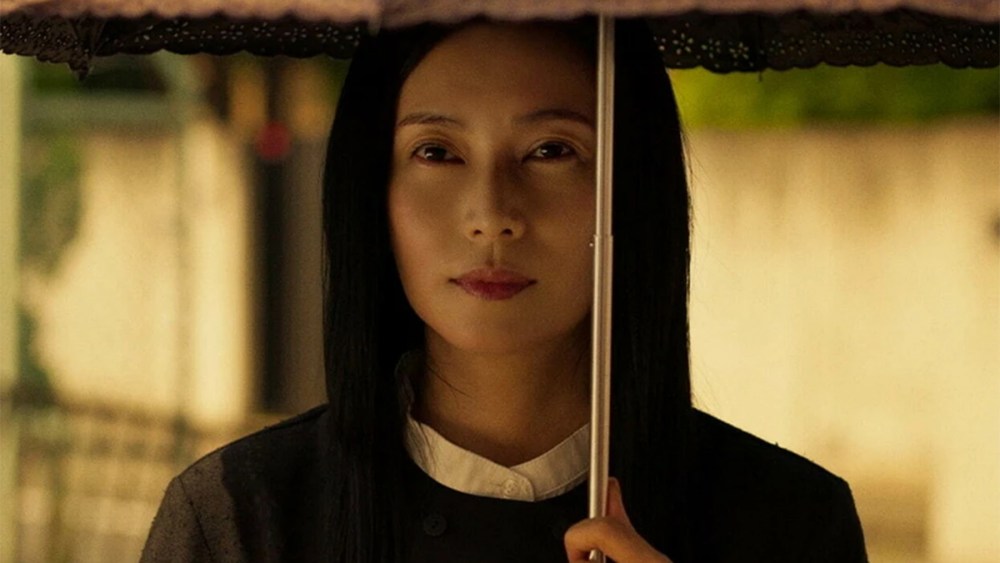
The actual story options definitive conclusions, and leaves no free ends in its pursuit of justice, delivered with a neat bow. “Sham,” nonetheless, is a film that trades in uncertainties, with a construction initially akin to Akira Kurosawa’s “Rashomon.” Miike first lays out the inciting accusations via the courtroom testimony of the mom, Ritsuko Himuro (Ko Shibasaki), in a prolonged prologue that reveals the vicious habits of trainer Seichii Yabushita (Go Ayano) in the direction of her son Takuto (Kira Miura). Earlier than lengthy, it quickly shifts gears in favor of an alternate telling from Seichii’s perspective (drawn from his personal counter-testimony), which makes up the vast majority of the film’s runtime.
The movie initially paints Seichii as a monstrous determine, however the reverse holds true when occasions are instructed from his perspective. The trainer turns into a hapless sufferer in what seem like extremely inconceivable conditions, orchestrated by a cartoonishly scheming Ritsuko to border Seichii. The conflict between these narrative extremes in a courtroom setting forces a better inspection of the very nature of authorized proof, and the idea of affordable doubt.
This thematic friction is finest described as delightfully uncomfortable. Miike’s typical notions of outward violence (in motion pictures like “Audition”) change into completely inside, and the battle for certainty begins to really feel emotionally risky. The viewer’s morality virtually turns into bifurcated: what one may consider is “proper” of their intestine may concurrently begin to appear completely incorrect inside authorized parameters. Miike, via his even handed use of close-ups and gradual unfurling of data, begins to tilt the share of energy between his characters in thrilling methods — which in flip forces the audiences to re-calibrate their very own beliefs on the fly.
Nonetheless, these ethically disorienting results can solely final so lengthy. The movie’s slavish dedication to its supply materials — the difficult of which might open its personal can of worms — calls for ignoring all potential complexity in favor of didactic conclusions. The film virtually teaches you to observe it with suspicion for a lot of its runtime, particularly since its narrative unfolds via particular views and courtroom proclamations. However the remaining catharsis that Miike presents is way too neat and linear for this strategy.
The lead performances from Shibasaki and Ayano are riveting and powerfully operatic. The 2 actors primarily embody 4 completely different characters — they every play virtuous and repulsive variations of Ritsuko and Seichii — yielding in a movie that calls for or not it’s seen via a lens of pure, subjective exaggeration, a method or one other. And but, there’s no second when it pulls again from this mode of storytelling, even when it appears to make a concrete willpower on which recounting has truly been goal all alongside, virtually discarding its personal visible lingua franca.
The result’s a film that, regardless of its emotional highs and difficult conundrums, strikes in the direction of extra historically euphoric conclusions that may’t assist however really feel mawkish, as they’re completely out of step with the previous runtime. “Sham” works till it very abruptly doesn’t, in a fashion that — mockingly — makes you query the character of every little thing you’ve simply seen, as if its successes have been unintentional or illusory.
The post Takashi Miike’s Courtroom Thriller Sheds Its Complexity appeared first on Allcelbrities.