
After watching Alexander Hammer’s “Anticipating Amy,” a 2020 docuseries about Amy Schumer‘s troublesome being pregnant, Jenn Freeman’s life modified.
Within the sequence, Schumer’s husband, Chris Fischer, is unexpectedly identified with autism. Fisher’s story struck a chord with Freeman, which prompted her to hunt an autism analysis. On the age of 33, Freeman, a celebrated dancer and choreographer, obtained an autism spectrum dysfunction prognosis.
Freeman reached out to Hammer, an previous pal, to congratulate him on the sequence and to share her latest prognosis. The following day, Hammer was in Freeman’s residence filming her.
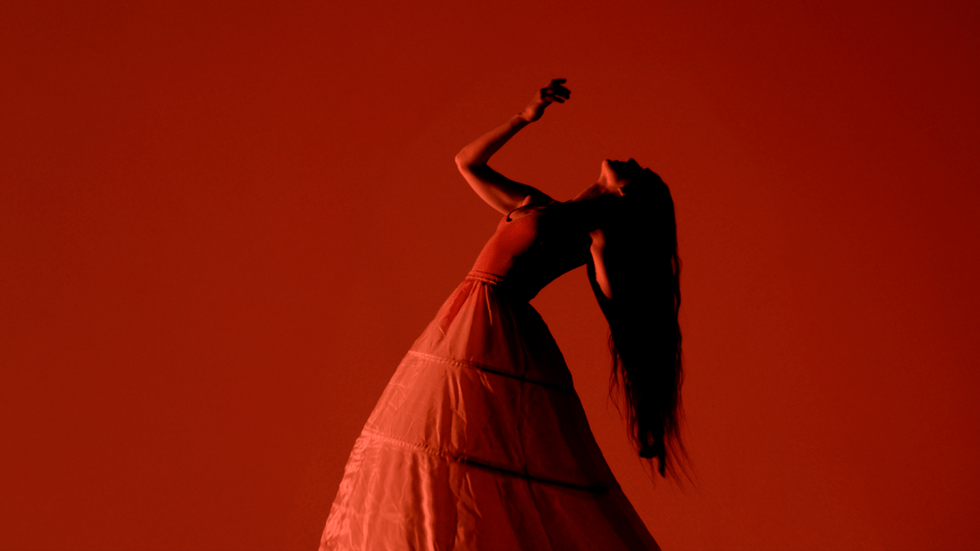
The result’s “Room to Transfer,” a documentary that follows Freeman as she navigates probably the most transformative chapter of her life. Govt produced by Schumer and Fischer, the doc captures Freeman over a five-year interval throughout which she develops an understanding of herself and creates a one-woman dance efficiency, “Is It Thursday But?”
Midway by way of the doc, Hammer unexpectedly turns into a topic of his personal doc after he’s identified with autism.
“Visually and structurally, “Room to Transfer” is layered and expressive,” says Hammer. “We weave collectively vérité footage, private archives, fragments from an evolving stage work, and poetic, impressionistic sequences that interpret the psychological terrain Jenn was navigating — sensory processing, masking, and the stress to carry out normalcy. Every thread provides a special emotional texture. The entire is supposed to really feel like reminiscence: shifting, nonlinear and deeply felt.”
Selection spoke with Hammer, Freeman, and Schumer forward of the Tribeca Fest’s “Room To Transfer” premiere on Wednesday.
Jenn, what was it about Chris’ autism prognosis in “Anticipating Amy” that made you assume you additionally might need autism?
Freeman: I had by no means thought even as soon as that I used to be autistic. I actually didn’t even know what autism was, however it was the best way that Chris’ household was speaking about him that one thing clicked. A few of the language that my relations have used to speak about me simply all the time felt like I used to be one thing apart from. Or a bit bit on the skin. After I heard Chris’s household speaking about him, it was overwhelming. I’ll by no means ever overlook that second after I was watching it. It was like a full-body, earth-shattering feeling.
You reveal a variety of private details about your self. Did you ever have any hesitations about making this doc?
Freeman: Regardless that it felt so scary, I simply knew to say sure. It’s like Chris and Amy had been courageous sufficient to share their tales, so I used to be going to be courageous sufficient to share mine, after which Alex was courageous sufficient to share his.
Alex, you discover out about midway by way of the movie that you simply even have autism. Any hesitation in your half about placing your self within the doc?
Hammer: I truly fought towards it for the longest time, and I used to be crushed down time and again, I believe, for the higher. Giving data and my private experiences with out going too far into them was a problem. However, I do assume that it offers a perspective that’s related but additionally totally different from Jenn’s, which simply provides one other layer to the story as a result of we’ve so many similarities and we’ve so many variations between the 2 of us. We’re simply two folks. We’re simply two out of what number of hundreds of thousands with autism.
Schumer: It’s so useful to get two people who find themselves going by way of it. That perspective is so useful.
Alex, when did you ask Amy to govt produce the movie?
Hammer: I introduced the concept to her instantly, and he or she mentioned, ‘Completely. Let’s determine this out.’ And that’s type of the motto of the movie as a result of we type of all went in being like, “We don’t know what that is, however it’s going be one thing.”
Amy, how would you describe your position on this movie?
Alex would ship me some tough cuts. I don’t know what it’s prefer to work with me as a collaborator, however I really feel like I used to be encouraging, and if I felt prefer it wasn’t there but, I shared that. I simply tried to be actually sincere.
Is likely one of the objectives of the doc to interrupt the stigma round autism?
Schumer: It’s to destigmatize it for certain. It’s one of many takeaways as a result of you realize, when all persons are seeing is “Love on the Spectrum,” which I like, or “Rain Man,” folks actually don’t have a lot of a reference for it. There aren’t that many people who find themselves out. My husband is out, and that may not be what everyone’s factor is, however sure, we need to undoubtedly de-stigmatize autism.
Freeman: That is embarrassing, however one of many first issues I did was Google celebrities who’re autistic as a result of it helps. You are attempting to see your self. Like, what does it appear like, and likewise you are attempting to see if I can have this factor and nonetheless have success or no matter. After I googled, I acquired Temple Grandin, and he or she is iconic, however I don’t actually see a lot of myself in her. So, I believe simply sharing totally different experiences (on the spectrum) is nice.
Schumer: I’ll simply add that the takeaway of this doc is to not get identified and fly your autism flag. It’s extra like – get the knowledge for your self or to your family members. Take a check. Discover out for your self. It’s such a useful factor to have the knowledge.
“Room to Transfer” is in search of distribution.
The post ‘We Need To Destigmatize Autism’ appeared first on Allcelbrities.