
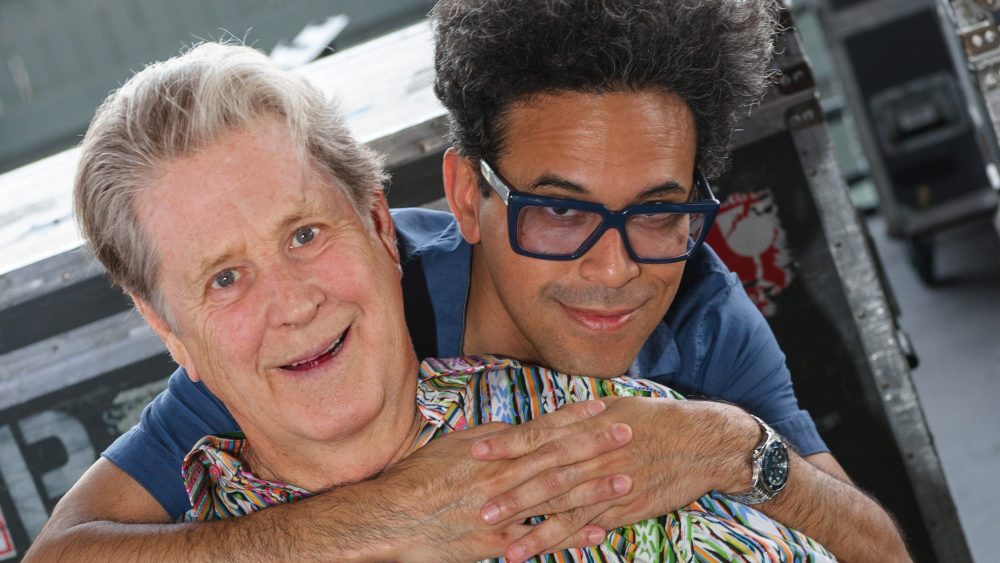
For the final quarter-century, nobody shared extra musical moments with Brian Wilson than Darian Sahanaja, who was a part of the Seashore Boys architect’s solo band from his return to stay exhibits in 1999 by way of his remaining tour dates in 2022. He was additionally a vital ingredient in bringing the “Smile” album again to life within the type of a solo Brian reconstruction, and served as supervising music guide on the 2014 biopic “Love & Mercy.” Selection invited Sahanaja to share his ideas about Wilson, who died this previous week at 82.
How ironic is it that Brian, the eldest of the three Wilson brothers… the “troubled one” with all of the bodily and psychological well being challenges… would find yourself being the final man standing? I imply, the man lived twice so long as his brother Dennis, who was the bodily ideally suited of an all-American surfer boy. Then once more, he was all the time defying the percentages. From the very first live performance I performed with him in March of 1999 — when it was predicted that he might not even make it by way of a track, not to mention a complete present — by way of to him overcoming some severe demons to search out closure to the unfinished post-“Pet Sounds” album “SMiLE,” the person might in some way attain deep down and discover the need energy to get by way of most any problem.
The method, nevertheless, won’t have been a clean one. In truth, practically all my favourite Brian tales are a product of him having to “work by way of the second.”
His awkward makes an attempt to get previous an uncomfortable state of affairs might end in pure comedy gold, or would possibly even be perceived as “genius.” If he wasn’t within the temper to satisfy guests backstage earlier than a present, they could say “Hello Brian, it’s an honor to satisfy you,” and his typical five-word response can be “Thanks … benefit from the catering!” At all times honest and by no means meant to be hurtful. Just like the time I used to be standing with him post-show when Eric Clapton walked over, instantly gushing concerning the music. Brian seemed on the each of us and stated, “Nicely… rock ‘n’ roll is right here to remain. (Pause.) It’s going to by no means die” — then rotated, walked 10 toes to his dressing room and slammed the door behind him. Eric and I turned to one another with palms up and simply needed to snort. Genius? Maybe. Sincere? Completely.
I write all of this as we within the Brian Wilson Band are making ready to affix Al Jardine for some exhibits that may spotlight songs off of the 1977 album “The Seashore Boys Love You.” The album is one in all my favorites within the catalog as a result of I discover it to be Brian’s most private effort after “Pet Sounds.” Despite the fact that 11 years had passed by, along with his voice now not angelic, the songs had been as stunning and heartbreaking as ever. And in contrast to the collaborative strategy of the 1966 album, this time round he authored the lyrics to 11 out of the 14 tracks on his personal. Are the matters advanced, the phrases deeply thought-provoking? With songs like “Johnny Carson,” “Airplane” and “Photo voltaic System,” one can be led to imagine they aren’t. However you’ll be able to’t deny the sincerity, the heartfelt great thing about the chords and melodies.
The opposite factor about that album is that Brian produced and performed practically every little thing on it. If there’s something I find out about Brian Wilson’s artistic course of, it’s that he was all the time going for rapid gratification. You possibly can even hear all through the “Pet Sounds” session tapes him getting impatient between takes to get everybody again to enjoying collectively once more. Not as a result of he was a management freak, however as a result of he was so anxious to listen to the components come collectively. Even with us in his band, he would rapidly feed every of us an element to sing or play and simply couldn’t wait to listen to all of it come collectively.
By the point of “The Seashore Boys Love You” in 1977, he had a number of keyboard devices at his disposal that would now mimic a string part, and others that would sound like a fuzz bass or brass. Most all of them had been of the newfangled analog synthesizer selection, and so as an alternative of getting to get string or brass gamers, and even having to strap a bass on, he’d merely seize a Minimoog or ARP synth keyboard and lay his concepts down in a fast and uncooked vogue, getting the rapid gratification he so needed. Then, simply as he did with “Pet Sounds,” he’d have the blokes are available in and lay down their vocal components. What we obtained in the long run was a totally distinctive assortment of songs and an album that feels like no different Seashore Boys file. Some of us even cite it as being the primary synth-pop file. At instances awkward, however principally attractive, catchy and honest. Genius? Maybe. Sincere? Completely.
On this previous yr, a couple of of us would go to him frequently, simply to take a seat and sing with him — simply wanting to maintain his musical gears spinning. Generally he’d take part, however principally he simply sat and listened, selecting to immerse himself within the sound of stay vocal harmonies and devices. For me, it was the least I might do. To have the ability to give again even a fraction of the enjoyment he’d given me. But in addition for serving to to make me the particular person I’m at present.

Blair McEvoy
As a pre-teen, I used to be ridiculed and even bodily abused by my so-called associates for favoring Seashore Boys music over the heavier FM rock acts of the mid-’70s they deemed as “cool.” But even that quantity of peer strain wasn’t sufficient to sway my opinion — a testomony of how good that music was to me. By the point I obtained to junior excessive, I used to be a lot better outfitted to handle criticism and was in a position to develop a strong understanding of what I did and didn’t like.
I needed to thank him for that. I needed to indicate him how grateful I used to be for all of the alternatives he gave me. To stay out the goals of each musician. To play Carnegie Corridor, the Hollywood Bowl, Sydney Opera Home, Royal Albert Corridor, Madison Sq. Backyard… to share the stage and mingle with the likes of Paul McCartney, Neil Younger, Bruce Springsteen, Elton John, Pete Townshend and even the Queen of England after performing for her at Buckingham Palace.
I imply, how does one presumably present gratitude for all of that? By singing a track by the Ronettes and making him smile.
Brian Wilson handed away in his sleep, at house, in his room. Simply as he would have needed it. The information didn’t upset me. I used to be saddened, sure, however primarily I felt reduction. I used to be relieved to know {that a} man who had suffered practically on daily basis of his life in a wrestle to search out a little bit little bit of peace and love was struggling no extra.
And with out getting overly New Testomony right here, I’ve all the time felt that it was by way of his wrestle, his craving, his reaching to discover a higher place, that we got such stunning music. How fortunate are we to have been alive whereas he walked this earth?
Brian Wilson (middle) on the world premiere efficiency of “Smile” on February 20, 2004 with band members Jim Hines, Darian Sahanaja, Scott Bennett, Probyn Gregory, Bob Lizik, Nelson Bragg, Taylor Mills, Nick Walusko and Jeffrey Foskett
Tim Whitby/WireImage
The post A Salute to Brian Wilson From Longtime Band Member Darian Sahanaja appeared first on Allcelbrities.