
The Japan-inclined daughter of a Belgian diplomat, Amélie Nothomb has revealed a number of books about her upbringing in Asia, together with one through which she boldly channels her internal toddler. In “Métaphysique des tubes” (or “The Character of Rain” in English), Nothomb spends a substantial period of time totally satisfied that she is God. “To start with,” opens the memoir, clearly evoking the Good E-book. It’s a contact that charmed many in print, however proves difficult to duplicate within the in any other case enchanting animated adaptation which premiered at Cannes, delighted Annecy and now finds its means stateside courtesy of Gkids.
As Nothomb remembers it, in these early years, she assumed the universe revolved round her, which makes “Little Amélie” (because the playful toon refers to its big-eyed, bobble-headed title character) a poetic have a look at the method by which a self-centered European lady born in a overseas land got here to grasp her place in society. A few of younger Amélie’s concepts are fairly unusual, as when she likens herself to a tube: Meals goes in a single finish and comes out the opposite. Gross, however simpler to simply accept than the entire God factor (which in fact she’ll finally outgrow).
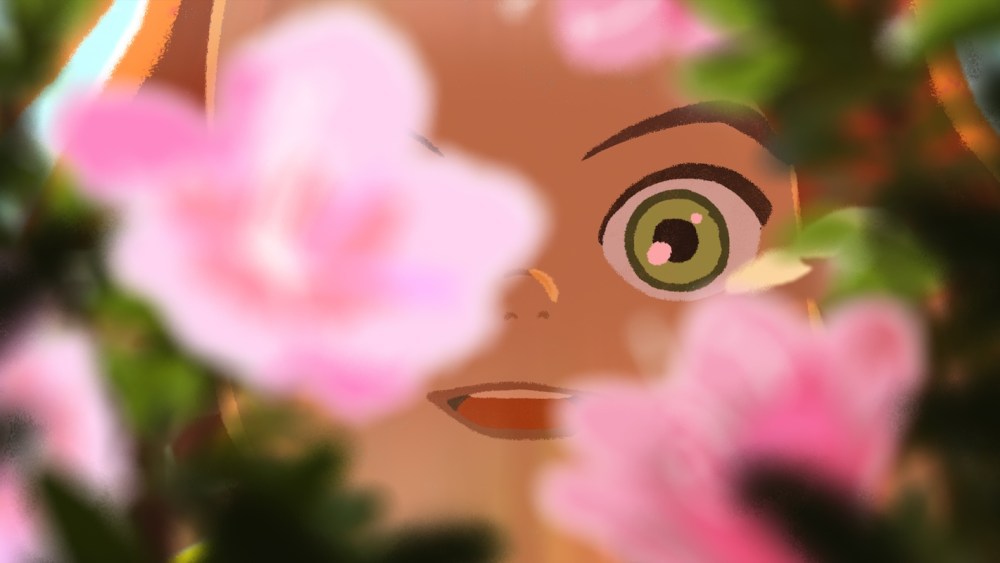
The place giant swaths of the guide had been devoted to articulating the psychological state of a 2-year-old, the film embraces a extra visible method, representing the world via Amélie’s eyes. And what charming eyes they’re: hypnotic yellow-green orbs, ringed in emerald! For these eager on surrealistic Belgian reinterpretations of the place children come from, you might discover extra elegant fashions in Jaco Van Dormael’s “Toto the Hero” (the film whose colourful model impressed that different “Amélie”) or “My Life in Pink,” a largely forgotten queer indie forward of the curve on trans identification.
All of which is to say, “Little Amélie” is hardly alone in providing a whimsical different perspective on birds, bees, storks and so forth, although its mannequin generally is a wee bit difficult to wrap one’s head round. Is she a deity or is she a tube? Does she possess distinctive powers or only a bratty sense of self-importance? We had been all 2 years previous in some unspecified time in the future, however Amélie’s worldview is neither intuitive nor common. It’s in the end through the main points that had been distinctive to Nothomb that the film most engages: being a Westerner in Japan, circa 1970, torn between two cultures, bonding with a neighborhood lady with out realizing the still-sensitive post-war historical past.
Filmmakers Maïlys Vallade and Liane-Cho Han, who tailored the guide with Aude Py and Eddine Noël, compress little Amélie’s God complicated into a brief prologue, focusing the majority of the 78-minute film on her formative reminiscences. As voiced by Loïse Charpentier, Amélie doesn’t fairly know what to make of her family — particularly her bullying older brother André (Isaac Schoumsky) — till her grandmother pays all of them a go to from Belgium.
The kindly matriarch wins over Amélie by feeding her white chocolate, and thus a primary human connection is made. Quickly after, Amélie warms to Nishio-san (Victoria Grobois), the younger Japanese lady who works as their housekeeper, forming a bond that serves because the movie’s backbone. As Amélie step by step learns to make sense of the world — parting the waters of the ocean to look at all of the creatures residing there, and setting up paper lanterns with Nishio for the Obon pageant of the lifeless — the film works its magic.
In these scenes, audiences are absolutely aligned with the precocious little lady, whose first phrase is neither “Mama” nor “Papa,” however “aspirateur” (“vacuum cleaner” in French). Amélie’s mother and father are understandably impressed when she proceeds to specific herself in full sentences, getting revenge on her brother André by talking everybody’s identify however his. All of it feels somewhat twee, till issues flip critical and Amélie experiences not one, however two near-death experiences — the way in which this “god” in the end comes to understand her personal mortality, but in addition handy alternatives for her to be rescued by characters she’d beforehand disliked (completely different from the saviors described within the guide).
Co-directors Vallade and Han’s minimalist visible model elegantly matches the younger character’s naiveté, forgoing the hand-drawn outlines we anticipate from anime and classic toons. As an alternative, we get fuzzy, barely pixelated edges that look smoothest on smaller screens. Human faces are represented with as few as 4 colours, concentrating our consideration on Amélie’s intense chartreuse eyes, whereas merely rendered backgrounds recall the work of creative collaborator Remi Chayé (who pioneered the look on “Lengthy Manner North”) and David Hockney’s late-career iPad work. Seems, all it takes is just a few blobs and squiggles to characterize a magic-hour backyard or timber erupting in cherry blossoms.
The feel and appear owes an apparent debt to the beloved movies of Studio Ghibli, which have supplied a number of the most iconic representations of wartime Japan and its lengthy, fraught restoration interval. “Little Amélie” begins from a spot of (principally endearing) solipsism and builds empathy and emotional depth because it goes. One scene specifically, through which Nishio-san dramatically prepares dinner whereas describing the devastation she witnessed, reveals the boundaries of Amélie’s creativeness. Some issues are past the capability of a kid to grasp, whereas others resonate most profoundly out of the mouths of babes.
The post A French Toon With an Unforgettable Worldview appeared first on Allcelbrities.