
It’s a cornerstone of film mythology that “Jaws” and “Star Wars” are eternally linked, like high-concept popcorn twins. They’re the films that, taken collectively, ushered within the blockbuster revolution. As the parable goes, “Jaws” and “Star Wars” launched the everlasting takeover of flicks by — for lack of a greater phrase — escapism. (Wanting on the Hollywood product of the final half century, I can consider far nastier phrases for it.) However immediately, on the fiftieth anniversary of the day that “Jaws” was launched, I’d wish to take the chance to de-link these two films.
In 1977, “Star Wars” was a sci-fi fantasy so potent and sq. and video-game zappy, one that may show to be so addictive to so many generations, that it successfully marked the beginning of our all-fantasy-all-the-time in style tradition. Its affect was past profound. It modified the consciousness of individuals. It made them wish to stay in different worlds. Clearly, it wasn’t the primary film or murals to do this. (In trendy occasions, you possibly can hint the world-building narcotic high quality of “Star Wars” again to “The Lord of the Rings,” with an help from “Dune.”) To me, although, the underside line is that it’s “Star Wars” that gave beginning to the film tradition we’ve got immediately.
However what of “Jaws”? When it opened on June 20, 1975, there’s little doubt that it felt just like the formative summer season film and the last word popcorn film. But it’s price noting that a substantial amount of what was revolutionary about “Jaws” needed to do with the unprecedented approach that it was distributed and marketed. It opened on 464 screens, all however extraordinary on the time, and the discharge was propelled by a advertising and marketing blitz that included an unprecedented $700,000 spent on two dozen nationwide tv promoting spots. This new stage of business saturation helped flip “Jaws” into an on the spot juggernaut, permitting it to dethrone “The Godfather” because the top-grossing film of all time in simply 78 days. That’s a variety of why “Jaws” is considered the unique summer season blockbuster.
Actually, although, blockbusters weren’t new. What was new was the time period blockbuster (a minimum of, as utilized to films), in addition to what the time period represented — a brand new mentality in Hollywood that may tilt the profit-vs.-quality equation towards a extra brazenly rapacious steadiness. And since all of that is so wired into the mythology of “Jaws,” it’s straightforward to consider “Jaws” as a film — or perhaps as the film — that incarnated Hollywood’s mid-’70s hairpin flip towards escapism.
Then once more, it’s price asking how true that truly is in a ’70s film tradition that had already given us such boffo bonanzas as “The Towering Inferno” and “Billy Jack” and “The Sting” and “The Exorcist” and “The Getaway” and “Shaft” and “The Final Home on the Left” and “The Longest Yard” and “Herbie Rides Once more” and “Willard” and “Summer time of ’42” and “The Life and Occasions of Grizzly Adams” and “Freebie and the Bean” and “Willy Wonka and the Chocolate Manufacturing unit.” I’d argue that “Jaws” is not any extra “excessive idea,” no extra decadently “escapist,” than any of these movies. I’d additionally argue that it’s a larger work of film artwork than any of them.
There’s no denying that the outrageous success of “Jaws” made it the primary high-profile step towards a basic change in film tradition. (“Star Wars” was a a lot greater step.) However after I watched “Jaws” once more the opposite day, marveling in each scene on the genius of the younger Steven Spielberg, what struck me in regards to the film isn’t how “escapist” it’s. It’s that each second of “Jaws” works as enthrallingly because it does as a result of your entire film feels so actual. Spielberg staged it with a verisimilitude that emerged instantly out of the New Hollywood ethos of the ’70s.
“Jaws” wasn’t some sharply angled flip away from the artistically staggering movies of the primary half of that decade; it was all of a bit with them. The opening sundown seashore occasion now performs like a free-flowing anticipation of “Dazed and Confused,” and within the morning-after scene, set within the house of Martin Brody (Roy Scheider), the brand new police chief of Amity, you possibly can really feel how a lot “Jaws” was directed by a filmmaker who wasn’t wealthy but; he nonetheless knew what it felt wish to get up in an odd home. Within the kitchen, Brody takes a police name as his spouse (Lorraine Gary) offers together with his son’s minimize hand within the background, and the scene is pure Robert Altman: two simultaneous overlapping realities. Watching “Jaws” once more, it hit me with full drive how influenced by Altman the movie was. It’s there within the sound design, within the a number of interactions going down on the similar time. You’re feeling it on the seashore, the place the folks we see by no means come off as extras in swimsuits — they’re all true characters intersecting at random.
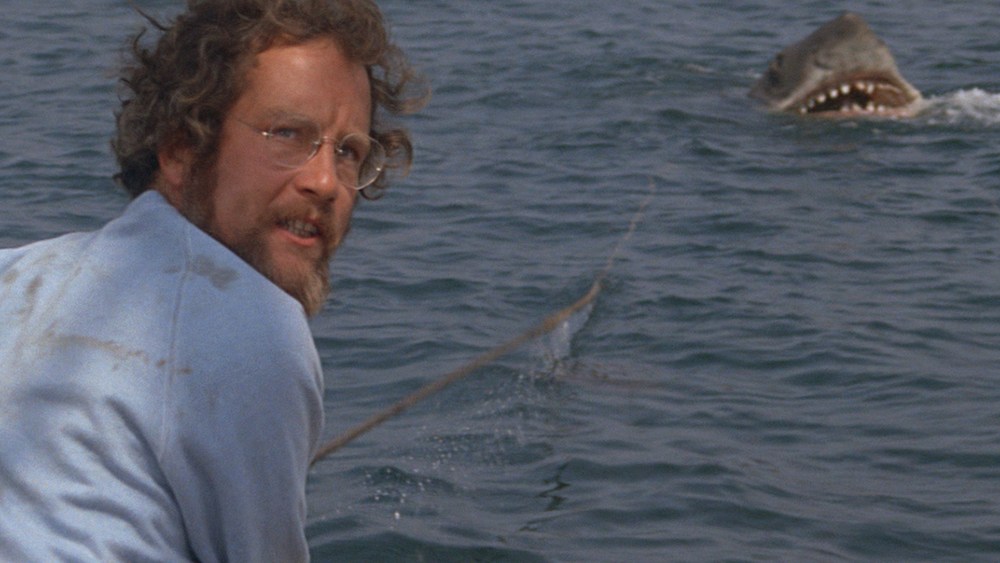
But that documentary-like sense of life that was Altman’s trademark, and that Spielberg drew on in “Jaws,” placing his personal kinesthetic stamp on it, isn’t only a matter of background-dialogue recording method, or of how the motion was framed. It’s actually about empathy. Spielberg noticed everybody on display as a person, and in doing so he turned scenes into dramatic juggling acts. He even does that, in a really Spielberg approach, in our first full-on view of the shark, that well-known off-the-beat second when Brody is tossing chum and speaking to somebody behind him and the beast out of the blue looms. Spielberg has a lot empathy that even his monster fish occupies its personal actuality.
“Jaws” was a lavishly genuine B horror movie; a ’70s greedhead conspiracy thriller; a “Moby Dick”-for-the-age-of-land-lovers journey saga; a drama of three males — outdated macho (Robert Shaw), new macho (Roy Scheider), and post-macho (Richard Dreyfuss) — competing on a ship; the last word scary funhouse prank on the viewers; and some of the completely executed films ever made. By all of it, the movie’s reality-based high quality is there in a thousand methods, large and small. It’s there in Lee Fierro’s sensible one-scene efficiency because the mom of the boy who will get eaten by the shark. It’s there within the unnerving ocean photographs shot at water stage. It’s even there within the shark itself: After all of the tales of how troublesome it was to get the three animatronic sharks to work, and the way pretend they might look (which is why the editor Verna Fields needed to disguise all of it with faster cuts), after I noticed “Jaws” the opposite day I discovered the shark — its eyes, motion, pores and skin texture, and jaws — to be astonishingly real, blowing away the form of digital results we now routinely settle for as eye-popping.
“Jaws” didn’t a lot finish the New Hollywood as cap it off, demonstrating that the impulses of Hitchcock and Altman might be fused. Within the movie’s second half, which is ready solely aboard Quint’s fishing boat, the film takes a flip into pure “motion,” but nothing that occurs throughout the prolonged man-.vs.-nature battle is hyped or implausible, staged in some over-obvious screw-tightening approach. It’s all spontaneous and natural, from the firing of the harpoons connected to yellow barrels to how the infrastructure of the boat slowly begins to come back aside to the undersea cage face-off to the best way that Quint slides, inexorably, into the shark’s mouth, as if karma had determined he belonged there.
Half a century after it was made, the message of “Jaws” — the lesson of it, to moviemakers and audiences immediately – is that an amazing piece of “escapism” isn’t about escaping actuality. It’s about utilizing actuality to create a catharsis that enables us, for a couple of moments, to flee ourselves. “Jaws” might have been Hollywood’s first official summer season blockbuster, however the reality is that it was the yin to the yang of “Star Wars”: the alternative of fantasy, a film that honored the deepest premise of flicks — to carry up a mirror to the world and have us look upon it with awe.
The post Films Ought to Really feel Actual appeared first on Allcelbrities.