
When the primary trailer arrived for “28 Years Later,” the third installment in Danny Boyle and Alex Garland’s masterful “28 Days Later” collection of horror movies, it was scary, full of ugly photos of zombies and a dystopian world.
However what makes the trailer much more terrifying is an eerie, rhythmic chant by a excessive, nasal voice, shifting with a navy cadence, monotonal at first however rising more and more louder and extra agitated because it goes on, with the photographs and ominous musical backdrop rising in pace and depth because it progresses.
In some way, in that context, the mantra, though the phrases appear unrelated to the photographs, is totally horrifying, like a deranged rap track. Its use within the movie makes an ominous scene much more ominous.
The mantra is definitely “Boots,” a poem by Rudyard Kipling, first revealed in 1903 and supposed to convey the maddening monotony of troopers marching; the direct inspiration was the lots of of miles British troopers had been pressured to march throughout southern Africa within the Second Boer Conflict across the flip of the final century, in accordance with the Kipling Society.
The recording used within the movie is sort of as previous because the poem itself, voiced in 1915 by actor Taylor Holmes. It’s a dramatic studying that begins off militaristic because the preliminary traces set the scene, however his voice is patently hysterical by the top, even because it follows the lock-step rhythm of the primary 5 syllables:
“I—have—marched—six—weeks in hell and certify
It—is—not—hearth—devils, darkish, or something,
However boots—boots—boots—boots—movin’ up and down once more,
And there’s no discharge within the conflict!
Attempt—strive—strive—strive—to think about one thing totally different
Oh—my—God—preserve—me from going lunatic!”
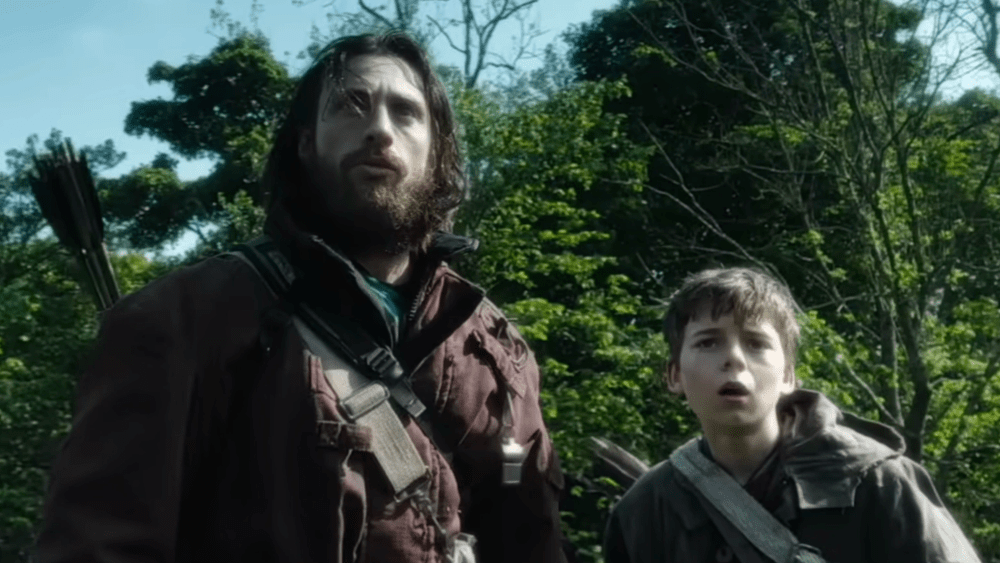
Unusually for one thing featured so prominently in a trailer, the poem performs a really small, though foreboding, position within the movie — buttressed with an eerie bass synthesizer, it soundtracks Spike and his father strolling to the mainland, which is thick with contaminated zombies, and presumably conveys that they’re marching to conflict.
However out of the whole lot that might have been used to ship that message, why a 110-year-old recording of a poem that dates again to the height of the British Empire? Boyle defined in an interview with Selection final week.
“We had all these archives that we needed to make use of to recommend the tradition that the island was educating its youngsters,” he says. “It was very a lot a regressive factor — they had been wanting again to a time when England was nice.
“It’s very a lot linked to Shakespeare,” he continues. “For those that know the ‘Henry the Fifth’ movie, there’s a really well-known speech, the Saint Crispin’s Day speech, which is in regards to the noble heroic English beating the French with their bows and arrows. We had been trying to find a track, for a hymn — for a speech, truly. We did consider using the Crispin’s Day speech at one level, however that felt too on the nostril.
“After which we watched the trailer — Alex and I bear in mind it vividly — the primary trailer that Sony despatched us, and there was this [recording] on it, and we had been like, ‘Fucking hell!’ It was startling in its energy. It was used very successfully.
“The trailer is an excellent trailer, however there was one thing greater than that about that [recording], about that tune, about that poem. And we tried it in our archive sequence, and it was prefer it was made for. it”
A rep for Sony wasn’t instantly in a position to pinpoint the one that selected the mantra for that trailer, but it surely was so efficient that Boyle was fast to include it into the movie.
“It’s like a reverse osmosis,” he says. “It got here into the movie and appeared to make sense of a lot of what we’ve been attempting to achieve for.”
He additionally notes that Kipling’s phrases and Holmes’ voice, echoing throughout the many years in a context neither ever may have imagined, by some means tackle a brand new energy in immediately’s context.
“You must maintain your hand up and say, ‘How is it that one thing that’s recorded over 100 years in the past has that very same visceral energy that it’s all the time supposed to have?’ And I feel it was all the time supposed to have that energy and it nonetheless maintains it. In a TikTok world, it nonetheless has that affect. It’s superb.”
The post That Terrifying Poem Chat Is a Rudyard Kipling Poem appeared first on Allcelbrities.