
Anybody who’s seen Nicola Coughlan in “Derry Women” is aware of that she’s a superb comedic performer. As nerdy teenager Clare Devlin, Coughlan made teenage anxiousness immensely bodily and palpable — firing her dialogue with all of the air in her lungs, strolling with a lot propulsive power she was almost tripping over herself.
In “Bridgerton” Season 3, Coughlan equally portrays adolescent turmoil, however via subtler and extra inner means. As wallflower Penelope Featherington, who harbors a double identification because the controversial Woman Whistledown, Coughlan was tasked not simply with making the ton’s resident introvert a mesmerizing lead but in addition with bringing humanity to her character’s morally ambiguous actions.
Coughlan nails it: the hit Netflix present’s third season sees Penelope absolutely step into the highlight as a romantic curiosity. In Penelope’s evolution, Coughlan captures how a younger lady’s coming of age is outlined as a lot by her personal private decisions as it’s by her wrestle towards society’s expectations for ladies. And Coughlan makes a case for herself as a wonderful dramatic lead, the sort that Emmy voters ought to take note of.

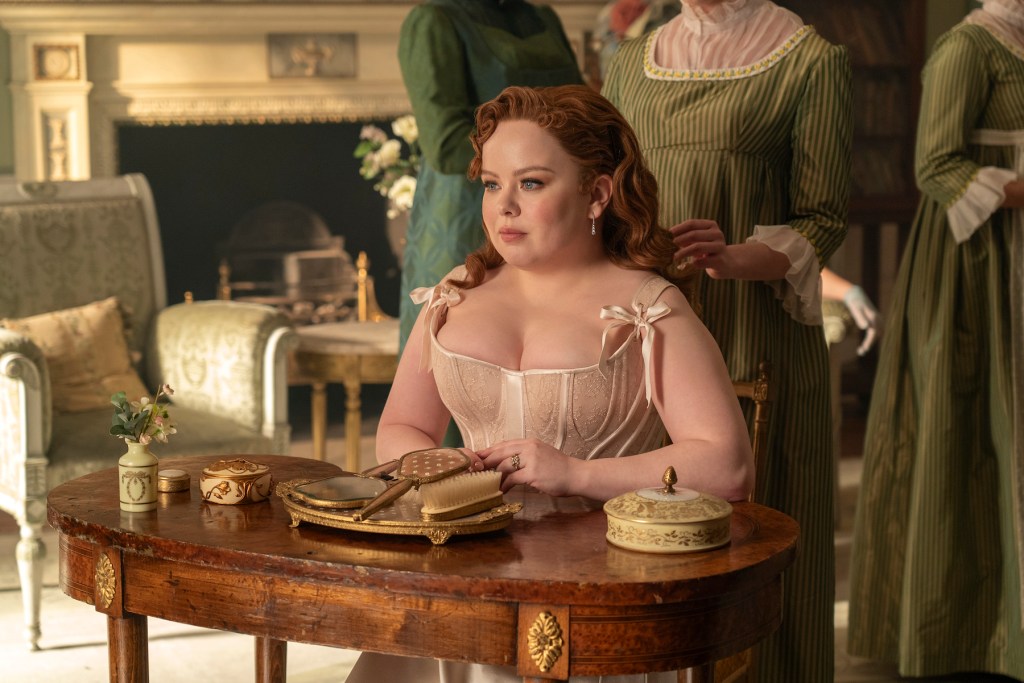
Bridgerton. Nicola Coughlan as Penelope Featherington in episode 307 of Bridgerton. Cr. Liam Daniel/Netflix © 2024
LIAM DANIEL/NETFLIX
That’s as a result of Coughlan has to reconcile two conflicting elements of her character. One is the usual teenage heroine. Penelope beforehand existed primarily on the sidelines, a spinster-to-be. Her transformation into the focal point is actually represented via a glow-up: there’s a scene by which she enters a ballroom sporting a totally completely different style and hair and make-up. Coughlan’s tentative delight as she notices the quantity of eyes on her immediately makes viewers root for her. She establishes Penelope as our favourite underdog.
This concept is sophisticated by the truth that Penelope wields precise energy because the nameless author behind an all-knowing gossip rag that may fully make or break somebody’s status. The journey that Penelope undergoes in turning into the principle character is one thing Woman Whistledown already pulled off; Penelope has been the principle character all alongside; it’s simply that now, she should come clean with that standing — together with the damage she brought about to realize it.
It’s to Coughlan’s credit score that these emotional threads keep collectively. She grounds Penelope’s characterization in a elementary sincerity. Penelope’s flaws are humanizing, by no means outright villainous, and neither are they fully ignored. She’s an clever younger particular person, however she’s not resistant to her age. Coughlan realistically captures what it’s prefer to be within the throes of adolescence, fumbling towards the particular person you wish to be.
Take, as an illustration, the scenes when Penelope tries to flirt with a gents for the primary time. Her awkward makes an attempt at dialog are extremely entertaining and charming as Coughlan leans into the cringe. For all of Penelope’s brilliance as a proto-journalist, she will’t assist her social inexperience.
Equally, Coughlan faucets right into a common feeling when Penelope asks her childhood buddy and longtime crush, Colin Bridgerton, to kiss her. Having simply run away from a ballroom the place everybody had been speaking judgmentally about her, Penelope tells Colin, “It might not must imply something.” Merely, “I don’t want to die with out ever having been kissed.” Coughlan brings coronary heart and sensitivity to Penelope’s eager for romantic validation.
And in Penelope’s pragmatic pursuit of a husband, Coughlan interprets her character’s inner wrestle. Penelope should safe a wedding, however she’s cautious about her romantic selections, as she prizes her independence and, after all, her work. A shot of Coughlan’s serving face within the midst of scribbling is actually memeable, however Coughlan does make the viewer perceive the gravity of Penelope’s mental endeavors and her hesitation at giving them up for love.
The evening earlier than Penelope’s marriage ceremony to Colin, she tells dressmaker Madame Delacroix that “I felt like I used to be dropping part of myself” when she tried to cease writing. It’s her final type of self-expression.
That’s the place Woman Whistledown originated from: a younger lady’s need for company. If Penelope’s strategy was messy and barely misguided, Coughlan’s portrayal signifies that her actions as Woman Whistledown generally mirrored the missteps of youth. “You have been a woman who didn’t know her personal energy,” Madame Delacroix additionally reminds her.
And so Coughlan imbues Penelope’s acceptance of accountability with the identical earnestness that she treats her character’s first romantic encounters. Penelope decides that going ahead, she’ll punch up relatively than punch down. As she states at one level, “I ought to’ve been utilizing the column to present a voice to the opposite unvoiced.” Regardless of the clichéd declaration, Coughlan makes Penelope’s good intentions and activist dedication plausible.
The evening earlier than her marriage ceremony, Madame Delacroix tells Penelope that “there’s no such factor as real love with out first embracing your true self.” By the top, we see Penelope settle for who she is, wallflower and alter ego mixed. It’s due to Coughlan’s nuanced efficiency that this merging of selves lands so seamlessly.
See Selection’s Emmy Predictions:
Awards Circuit: Emmys
The post Why Nicola Coughlan Deserves an Emmy for “Bridgerton” Season 3 appeared first on Allcelbrities.