
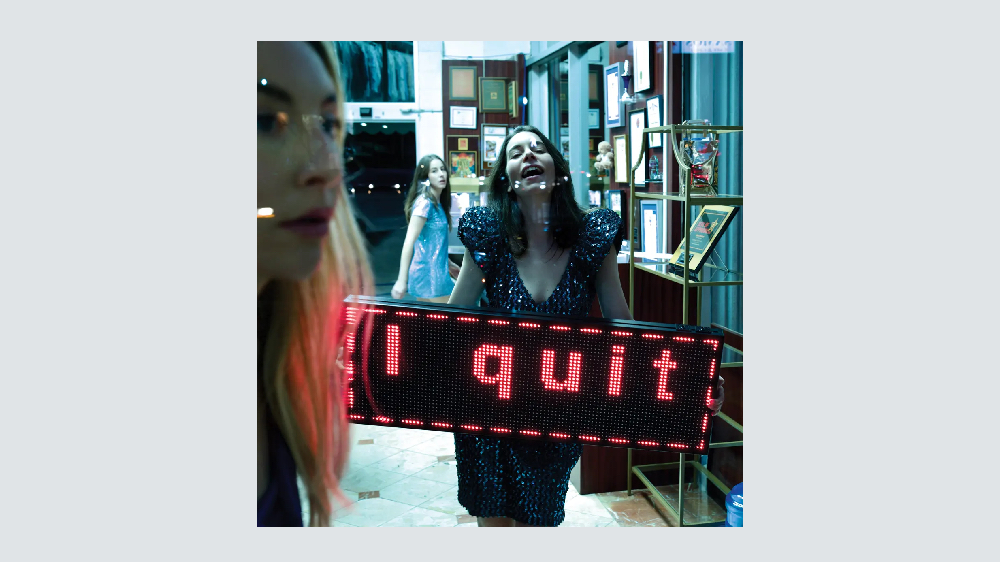
Kudos to Haim, to start with, for one of the best album title of the 12 months. Breakup albums are so frequent that it’s stunning nobody beforehand had the temerity and/or genius to call such a file “I Stop.” If that bluntness sound somewhat prosaic at first, there’s a curt poetry to it that comes into focus listening via 15 tracks that consist virtually totally of sisters Danielle, Alana and Este Haim handing of their respective resignations to long- or short-term companions, successfully instantly. Who can be cleansing out whose desk could also be in query (“You packed my shit / But it surely’s nothing I wanted,” Danielle informs her ex within the opening minimize, “Gone”). However there’s no challenge as to who’s lastly the boss… or the triune bosses, within the case of this sisterhood.
Danielle revealed in pre-release promo for the album that it captured a time when “we had been all single on the similar time for the primary time since highschool,” which is helpful backstory, and likewise one thing that we would virtually have come round to guessing on our personal, given the consistency of themes on this fourth album. Other than just a few notable outlier songs, “I Stop” has a reasonably extreme focus on “why I left” (or “why I’m about to”) themes — and together with that narrowing of lyrical issues, there’s a concurrent streamlining of their sound, too. These two issues really feel type of linked: The break up Danielle Haim is presumably writing about was with Ariel Rechtshaid, who was a major co-producer/co-writer on the earlier three information. His absence doesn’t make for a complete 180 reversal; Haim’s different main standing collaborator, Rostam Batmanglij, remains to be on board co-producing with Danielle, so there are nonetheless factors of sonic continuity. What Rechtshaid took with him, for higher or worse, are a number of the quirky and intelligent aural landscaping that marked 2020’s “Ladies in Music Pt. III.” When you needed Haim to be a bit extra of the rock band on file that they’ve at all times been on stage, this can be a newly impartial step again in that path, together with all of the extra private declarations of indie-pendence.
There are tradeoffs, after all. When you appreciated “WIM III” as type of their White Album (and I’d nonetheless price it among the many greatest information of the last decade, 5 years later), there’s one thing to be missed from that heightened eclecticism, on this considerably extra minimalist method. On the similar time, I appreciated listening to Danielle (a multi-instrumentalist) get bashier on the drums on “All Over Me,” or contributing energy chords and a flipped-out guitar solo to tracks like “Gone.” It appears like getting nearer to the supply of what the band would possibly sound like within the rehearsal studio, with much less sense of anybody else placing a stamp on that. (With apologies to Batmanglij, the ex-Vampire Weekend man, who in all probability leaves a wonderfully sturdy imprint, only one that’s much less evident.)
These aforementioned outliers, the numbers that maintain “I Stop” from utterly settling right into a temper? Effectively, if you happen to’re a fan, you’ve already had three months to settle in with the leadoff single, “Relationships,” which goals to make some enjoyable out of home drollery with chanty asides and a ’90s R&B really feel that feels akin to a number of the band’s different previous detours out of a rock realm, with a little bit of funk bass and a drum monitor that feels mechanical, even when it’s not. “Take Me Again,” in the meantime, is probably the most blatant stab at kicking the album’s capital-F-fun quotient up just a few critical notches; it’s a fast-chugging, hand-clapping dip into affectionate nostalgia for the San Fernando Valley misadventures of the sisters’ rowdy teenagers and post-adolescence, naming names in some cases. (“Alana misplaced her head when she had a crush / Billy St. Reams didn’t wanna fuck” — sure, it sounds somewhat like “Individuals Who Died,” besides with individuals sharting as a substitute of OD-ing behind the truck.)
“Million Years” is one other critical departure from the remainder of the file: It’s breakbeat time! And in addition a uncommon time on the album wherein the sisters permit themselves the opportunity of transcendent romantic love, theoretically, a while in a California beach-haze future. “Spinning” mixes up disco and a few faintly “1999”-era synth touches, as a mattress for Alana to think about getting dizzy with infatuation.
However on the subject of “Relationships,” if you happen to’re questioning what these women’ place on that topic is… properly, it’s just about towards, typically. That’s even the case for one of many album’s cheerier numbers, “All Over Me,” a extremely carnal ditty that appears to be in regards to the glories of revenge coitus. At the least, it’s very sex-positive and monogamy-negative. “You recognize I’ve at all times had a wild coronary heart / And that received’t ever change / So if you see me out with another person / I cannot be ashamed,” sings Danielle, with lyrics that extol the advantages of getting a fuckboy: “I do know it’s not fairly what you need, being on name for me… / Your mattress or my flooring / However don’t inform me that you just’re in love / ’Trigger I’m not attempting to stroll the road.” Possibly solely feminine artists might get away these days with that cavalier of a historically male angle about situationships, nevertheless it feels as daring because it means to be.
So these are the tracks that determinedly break from the overriding tone that runs via the opposite songs, which is moderately extra glum, or at the least looking out and reflective about why an excessive amount of time received wasted in an extended, nowhere love affair. A few of the splitsville songs on the album mix collectively a bit; there are moments the place chances are you’ll mentally flag an particularly good breakup line, then notice that it additionally might simply as simply been positioned in a number of different tunes that run alongside the identical traces. However the entire album, or most of it, is an admission that it’s exhausting to get unstuck to start with from a no-longer-functioning relationship, then get unstuck from spending additional time attempting to make retrospective sense of it. It’s about overthinking the aftermath of one thing you didn’t spend sufficient time considering via whereas it was occurring. So having a few of these songs run via the identical emotional floor is neither a function or a flaw; it simply is. They usually’re good firm, these Haims, after they’re letting their Superfun Sister Trio guard right down to attend to the enterprise of mulling.
If Haim is “Right down to Be Improper,” we don’t wish to be proper. That’s a solidly low-key quantity that has Danielle singing about being the one who leaves, not the one who’s left, and the temptation to be guilted out of giving up on that resolve, or at the least regretting it. “I left you you the keys / I left on the lights / I locked myself out of the home / I’m on the following flight,” she sings, over barely greater than a snare and hi-hat at first. There can be explanations: “Boy I crushed my complete coronary heart / Making an attempt to suit my soul into your arms / And I crushed up these drugs and I nonetheless couldn’t take ’em” — that is unhappy stuff, however you’ll be able to’t assist noticing there’s one thing that sounds as playful because it does poignant. All of the sudden, there’s a loud rhythm guitar break that’s proper out of Tom Petty’s “Free Fallin’.” Whether or not the reference is supposed to be deliberate or not, the impact of this music is just not in contrast to that one: It might probably really feel exhilarating to depart somebody behind, even if you happen to’re not optimistic you aren’t plunging.
“The Farm” is a extra mild and in some way extra wry spotlight among the many breakup songs, starting with an acoustic guitar opening that appears like a nod to “You Can’t All the time Get What You Need,” earlier than describing a break up within the sensible phrases of a enterprise choice: “We might carry on attempting / Or we might promote the farm / Simply purchase me out.” These final 4 phrases make up among the finest and bluntest traces within the Haim catalog — an awesome, if super-quiet, second of can’t-cry-anymore catharsis.
Now, they do have a music referred to as “Cry” on the album, and it unironically lives as much as its tearjerker title, as a near-country ballad the place Este exhibits some actual vulnerability about being someplace amid the “seven levels of grief” after strolling out. However this, too, is an outlier. When you’re on the lookout for a dominant emotion in “I Stop,” return to that album title, the place, in Johnny Paycheck trend, they’re telling Mr. Improper to take this job and shove it. Precise regrets? Virtually too few to say.
And the Haims are good firm in nuanced-but-defiant mode. The album’s greatest monitor is perhaps its nearer, “Now It’s Time,” which supplies U2 co-writing credit score mainly for having lifted a few energy chords from the music “Numb” … and, positive, an entire rocking coda that type of nods to that band’s ’90s sound. Danielle sounds newly woke up, not numbed, as she sings about being proactive in transferring on as a substitute of obsessively specializing in the need for an apology.
How will you not fall for an album that, after having gone virtually type of mushy on us for just a few tunes, comes again round to feisty level A, ending with the couplet: “Am I reaching out to say / I by no means gave two fucks anyway?” They did give this album the correct title, however “Ladies in Music Pt. F.U.” would’ve labored, too.
The post Haim Explores Rocky Romantic Resignation in ‘I Stop’: Album Overview appeared first on Allcelbrities.